
We offer more than 75 crushed stone products available in a variety of colors, sizes, and gradations.
What Is Roller-Compacted Concrete? Uses, Benefits + Installation
Roller-compacted concrete (RCC) is a durable pavement solution that combines the strength of concrete with an installation process similar to asphalt paving. Designed for large industrial and commercial applications, RCC has become an increasingly popular choice for distribution centers, manufacturing facilities, ports and other heavy-duty pavements where long-term performance and construction efficiency are priorities.
Unlike conventional concrete, which is poured into forms and finished by hand, roller-compacted concrete uses a much drier concrete mixture that is placed with specialized paving equipment and compacted using vibratory rollers.
Here’s what roller-compacted concrete is, how it’s installed, where it’s commonly used and why it may be the right solution for your next paving project.
What Is Roller-Compacted Concrete?
Roller-compacted concrete (RCC) is a zero-slump concrete that is placed with specialized paving equipment and compacted using vibratory steel rollers rather than finished like conventional concrete.
Unlike traditional ready-mix concrete, RCC contains much less water, giving it a stiff consistency that allows construction equipment to travel over it during placement. Once compacted, the pavement develops into a dense, durable concrete surface capable of supporting heavy loads.
Although the installation process resembles asphalt paving, RCC is still concrete. It contains cementitious materials, aggregates and water, the primary difference is the consistency of the mix and the method used to place and compact it.
Why Is RCC Growing in Popularity?
Owners and developers are increasingly looking beyond initial construction costs and focusing on total lifecycle value.
For many industrial facilities, warehouses and distribution centers, pavement is expected to perform for decades while supporting thousands of heavy truck movements each year.
Frequent maintenance or replacement can disrupt operations, increase costs and reduce productivity.
Roller-compacted concrete offers another option, one that combines the long-term durability of concrete with a high-production installation process that can help keep projects on schedule.
How Is Roller-Compacted Concrete Different from Conventional Concrete?
Although both are concrete pavements, the similarities largely end there.
Traditional concrete uses a workable mixture that can be poured, consolidated and finished before it hardens. In the concrete industry, this workable state is often referred to as the plastic state, meaning the concrete can be shaped and finished before curing.
RCC uses a much drier mixture with little or no measurable slump. Rather than being poured into forms, it is placed continuously using a specialized paver before being compacted with vibratory rollers.
| Conventional Concrete | Roller-Compacted Concrete |
| Workable concrete mixture | Very dry, zero-slump mixture |
| Placed into forms or by slipform paver | Placed with specialized RCC paver |
| Consolidated with vibration | Compacted using vibratory rollers |
| Finished using conventional concrete finishing techniques | May receive additional surface finishing depending on project requirements |
| Well suited for a wide variety of pavement shapes | Best suited for large, open paving areas |
Neither system is inherently better. The best choice depends on the project’s size, geometry, schedule, loading requirements and long-term performance goals.
How Is Roller-Compacted Concrete Installed?
Although every project is different, most RCC paving follows the same general process.
- Prepare the Base: Like any pavement system, long-term performance begins with proper site preparation. The subgrade and base must be engineered and compacted to support anticipated traffic loads.
- Produce the RCC Mix: Because RCC has a very narrow moisture tolerance, consistent batching is essential. Small variations in water content can affect workability, compaction and final pavement quality. Close coordination between the concrete producer and paving contractor helps ensure the material remains consistent throughout production.
- Transport the Material: RCC must be delivered efficiently from the concrete plant to the paving operation. Reliable trucking and logistics help maintain a continuous paving process while minimizing delays.
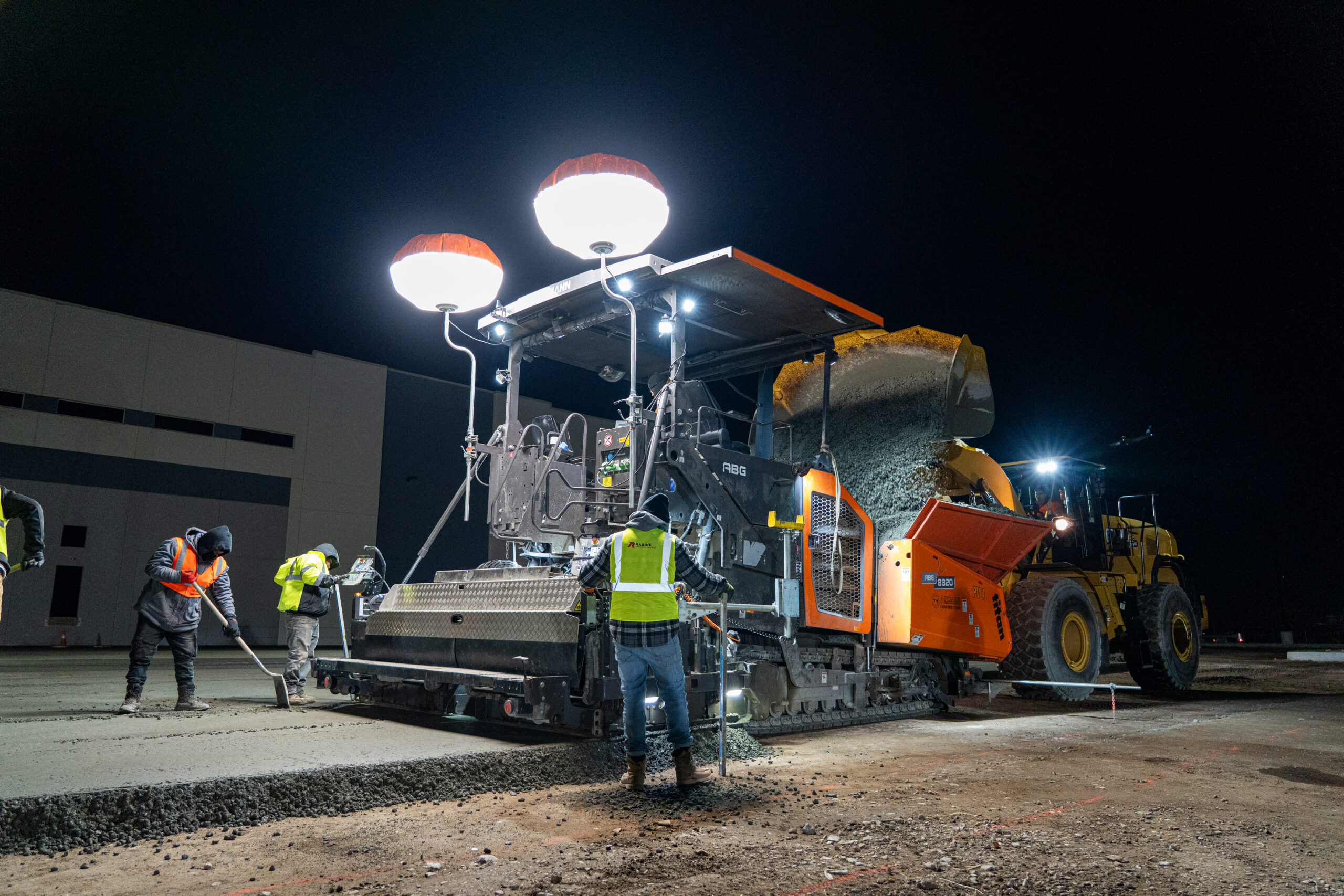
- Place the Concrete: Specialized RCC pavers spread the material in continuous passes across the prepared surface. Unlike conventional concrete paving, RCC performs best when crews can make long, uninterrupted paving runs across large pavement areas.
- Compact and Finish: Immediately after placement, vibratory steel rollers compact the concrete to achieve the required density. Depending on project specifications, contractors may also apply additional finishing techniques to improve the appearance or surface texture. Like all concrete pavements, RCC must then be properly cured to promote strength development and long-term durability.
See Roller-Compacted Concrete in Action
Watch this behind-the-scenes look at a 354,000-square-foot industrial paving project in Newark, New Jersey, where Rabine Group placed approximately 8,000 cubic yards of roller-compacted concrete supplied by Silvi Materials. In the video, Rabine Project Manager Saul Ruiz explains how RCC is placed and why it’s an effective solution for large-scale industrial paving projects.
What Are the Benefits of Roller-Compacted Concrete?
For the right application, RCC offers several important advantages.
- Faster Installation: Because RCC is placed continuously using paving equipment, contractors can often complete large pavement areas more efficiently than with some conventional concrete paving methods. This makes RCC particularly attractive for projects where construction schedules are critical.
- High Strength: Once compacted, RCC forms a dense concrete pavement capable of supporting heavy industrial traffic, including tractor-trailers, forklifts and other equipment commonly found at logistics and manufacturing facilities. Actual pavement performance depends on proper engineering, mix design and construction practices.
- Long Service Life: Concrete pavements are known for their durability, and RCC is no exception. When properly designed and maintained, RCC can provide decades of service while requiring less routine maintenance than many asphalt pavements. Actual service life depends on factors including traffic loads, pavement design, drainage, climate and maintenance practices.
- Lower Lifecycle Costs: While RCC may have a higher initial construction cost than asphalt in some markets, many owners evaluate pavement based on total cost of ownership rather than first cost alone. A longer-lasting pavement with reduced maintenance requirements can lower costs over the life of the facility while minimizing disruptions to daily operations.
- Reduced Maintenance: Industrial facilities often operate around the clock. Fewer major pavement repairs can mean fewer interruptions to truck traffic, shipping operations and facility access.
Where Is RCC Commonly Used?
Roller-compacted concrete is typically best suited for large pavements subjected to heavy traffic. Common applications include:
- Distribution centers
- Warehouse truck courts
- Manufacturing facilities
- Industrial yards
- Ports and terminals
- Intermodal facilities
- Equipment storage areas
- Large commercial parking lots
- Heavy-duty access roads
Large, open sites allow paving crews to maximize production and efficiency.
When Is RCC Not the Right Choice?
Like any construction method, RCC is not appropriate for every project. It may be less suitable when:
- The pavement area is relatively small.
- The site contains numerous curves, islands or tight radii.
- Equipment must work immediately adjacent to buildings.
- Numerous utility structures interrupt paving operations.
- Decorative finishes are the primary design objective.
In many projects, contractors use conventional concrete in confined areas while using RCC throughout the larger pavement sections.
Understanding where RCC performs best (and where it doesn’t) is an important part of selecting the right pavement solution.
RCC vs. Asphalt
Owners frequently compare roller-compacted concrete with asphalt because both are installed using similar paving equipment.
While each has advantages, the decision often comes down to project priorities.
| Asphalt | Roller-Compacted Concrete |
| Typically lower initial cost | Often lower lifecycle cost |
| Flexible pavement | Rigid concrete pavement |
| Requires periodic maintenance | Generally lower long-term maintenance |
| Well suited for complex layouts | Best for large, open pavement areas |
| Faster to repair | Longer potential service life |
Rather than asking which pavement is “better,” owners should evaluate which system best aligns with their budget, schedule, traffic demands and long-term operational goals.
What Makes an RCC Project Successful?
Successful RCC projects require more than simply producing concrete. They depend on close coordination between:
- Engineers
- Concrete producers
- Trucking operations
- Paving contractors
- Quality control personnel
- Project managers
Because RCC has a relatively short placement window, communication and consistency are critical from the concrete plant to the finished pavement.
Experienced teams understand how to maintain production, monitor quality and keep paving operations moving efficiently.
Frequently Asked Questions
Is roller-compacted concrete the same as asphalt?
No. Although RCC is installed using equipment similar to asphalt paving, it is concrete made from cementitious materials, aggregates and water.
Why is RCC called zero-slump concrete?
Unlike conventional concrete, RCC contains very little water and does not flow when tested using a standard slump test.
Can RCC support heavy truck traffic?
Yes. RCC is commonly used for industrial pavements designed to carry heavy commercial vehicles and equipment.
Does RCC require joints?
Joint requirements vary by pavement design and project specifications. The project’s engineer should determine the appropriate jointing strategy.
Can RCC have a smooth appearance?
Yes. Modern finishing techniques can produce a much smoother appearance than the rough RCC surfaces commonly associated with earlier installations.
Is RCC less expensive than asphalt?
Not always. While initial construction costs vary by project and location, RCC may offer lower lifecycle costs through increased durability and reduced maintenance requirements.
Choosing the Right Pavement for Your Project
Roller-compacted concrete has become an increasingly attractive pavement solution for owners seeking a durable, high-performance alternative for large industrial applications.
Its combination of rapid placement, structural strength and long-term value makes it particularly well suited for facilities where heavy traffic, operational uptime and lifecycle costs are key considerations.
However, no pavement system is right for every project.
The best results come from evaluating project size, site layout, traffic loading, construction schedule and long-term ownership goals before selecting a pavement system.
Working with an experienced concrete producer and paving team can help determine whether roller-compacted concrete is the right fit and ensure the pavement is designed and constructed to deliver reliable performance for years to come.
Planning a large industrial paving project? Silvi Materials supplies high-quality concrete for commercial and industrial applications throughout the Northeast. Contact our team to discuss your project.


